
This story originally appeared in The Centre County Gazette.
BELLEFONTE — Food insecurity is on the rise across the United States, and according to a report from a major regional food bank, Centre County is far from excluded in that statistic.
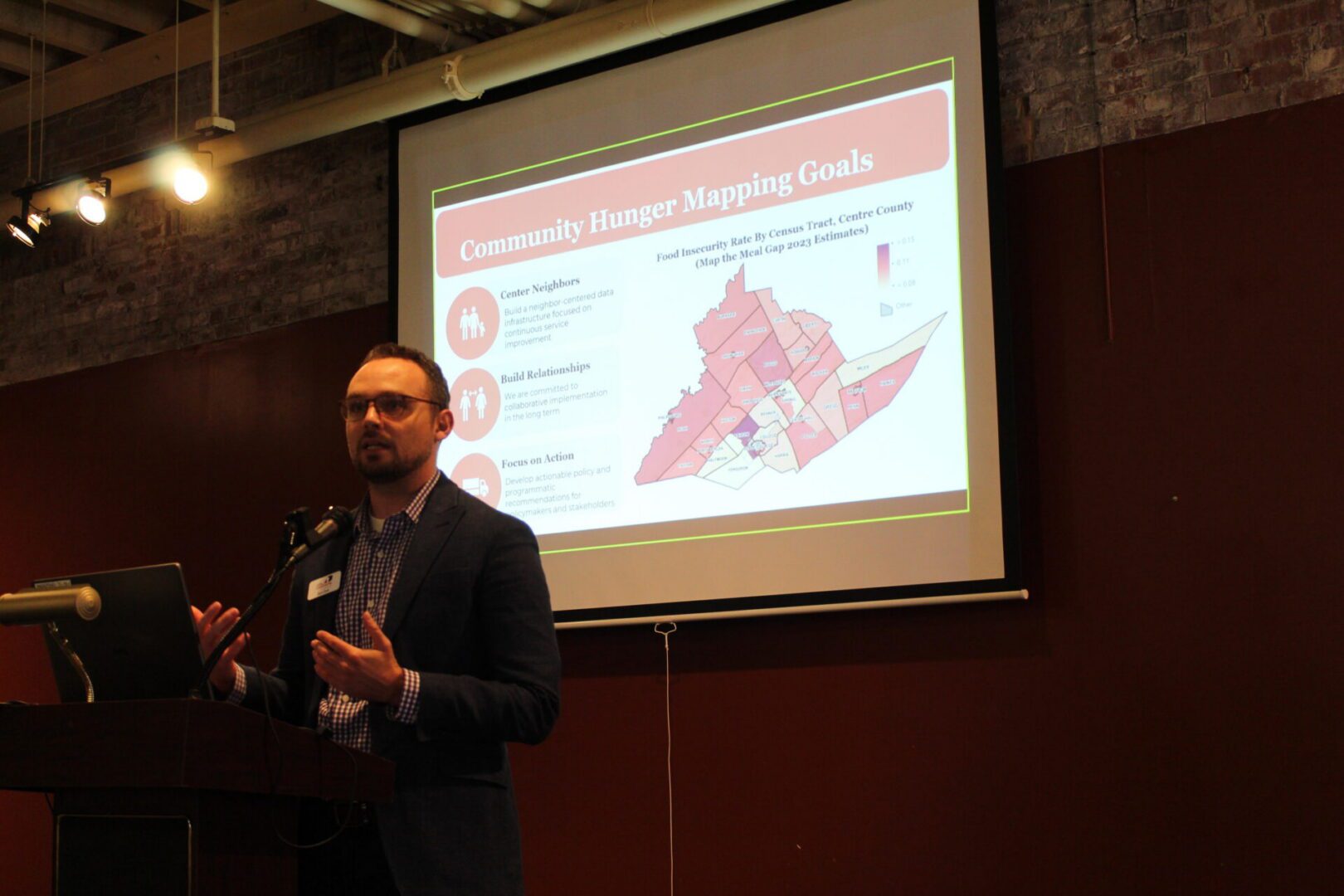
Central Pennsylvania Food Bank presented their final Centre County community hunger mapping report last Wednesday at the American Philatelic Society in Bellefonte, and its findings showed that food insecurity impacts “just under 20,000,” or 12.5%, of the county’s residents — one in every eight people — and a rise of around 40% from 2021 insecurity levels.
The report also shared that one in every six children — more than 3,500, or 15.4% of the county’s children — lacked consistent and reliable access to the food they need to live a healthy lifestyle, and that food insecurity is most often faced by people living in the county’s most populated areas.
“We have found that these reports have been incredibly helpful at galvanizing community action around food insecurity, which is just a really immense issue across not only Centre County but really the entire state of Pennsylvania and the United States,” Zach Zook, the CPFB’s Chief Strategy Officer, said.
He continued, “The trends as it relates to food insecurity are really troubling, specifically to how food insecurity has evolved over recent years, but we can reduce those rates.”
Carried out by interviewing more than 250 households and 13 of the county’s food pantries, the report took years to complete, and Centre County is the 19th county to have a completed report.
While it plainly earmarked the number of residents who are experiencing food insecurity, the report also provides starting points and approaches to reduce insecurity that the CPFB, local pantries, municipalities, nonprofits and more should build upon moving forward.
“Our commitment to you is to keep listening to you and to the neighbors, and to work collaboratively toward expanding the services, accessibility and welcoming environments to the people that we’re serving,” CPFB Senior Vice President and Chief Program Officer Tara Davis said.
To combat Centre County food insecurity, the CPFB outlined three approaches local entities should take: strengthening and increasing the availability of the charitable food system; encouraging robust participation in key government nutrition programs; and addressing “upstream and intersecting” issues that cause food insecurity.
In the first approach, the CPFB recommended that pantries simplify the intake processes and requirements to lower access barriers for people to access food, such as proof of income, lease agreements and more, to solely an admission of need.
The first approach also urges local pantries to increase hours of operations to evening and weekend distributions, to work to reduce wait times for pantry visitors receiving food by increasing volunteer capacity and for the public, local municipalities, businesses and other organizations to invest more into their local food pantries.
“It’s really important to note that not every pantry has to be open all the time because that’s impossible,” Zook said. “But working together as pantries across the county, we can make sure that there’s access every single week to off-hours locations, whether it be a Saturday, an evening or certain day of the week, so that it suits the most folks who might need that access.”
The second approach specifically urged residents to enroll in the Supplemental Nutrition Assistance Program, and urged the county and other local entities to implement more SNAP outreach methods, as Centre County ranks 57th among Pennsylvania’s 67 counties in SNAP participation.
Getting more residents to participate in the Special Supplemental Nutrition Program for Women, Infants and Children was also strongly urged, as Centre County has one of the lowest participation rates in the state, ranking 55th out of 67.
“There’s some opportunity to do outreach at pantries to get folks connected with WIC, but also to consider opportunities like mobile WIC clinics or on co-located WIC outreach at pantries from the county WIC office,” CPFB Policy Research Specialist Morgan Flood said. “These are things I’ve seen work in other counties.”
The third approach highlights the state, county and local municipalities tackling issues like poverty, low income housing, greater transportation services, upping the minimum wage and more.
“One in 20 Center County pantry visitors had experienced an eviction foreclosure or other forced move in the last year, and one in nine was worried about it,” Flood said. “We have folks tell us all the time they pay their rent first before anything else, and I ask them if that leaves them short on your groceries, and they always say ‘well, yes, of course.’”
Moving forward, the CPFB is looking to work with local entities to try and implement their
approaches, although a timeline for the implementation of any of those approaches was not shared.
More Local News
View all Local News
Local Historia: A Lincoln Like No Other
How Bellefonte-born sculptor George Grey Barnard’s unconventional vision of Abraham Lincoln sparked an international debate

Woman Accused of Using Racial Slur, Threatening State College Apartment Manager With Knife
State College police on Wednesday arrested a Penn State student accused of threatening a downtown apartment building property manager with a butcher knife and calling him a racial slur. Alexa […]

Section of Atherton Street in State College to Be Closed on Monday
Part of a busy downtown State College road will be closed to traffic for about six hours on Monday, Nov. 2. South Atherton Street between West College and West Beaver […]


